
In Flanders Fields Poem: A Comprehensive Guide (April 14, 2026)
Recent Windows updates (KB5074109, KB5085516, KB5079473) highlight Microsoft’s commitment to security. Accessing a “In Flanders Fields” PDF requires caution; ensure legitimate sources are utilized for downloads, safeguarding against potential risks.
Historical Context of World War I
The Great War, as it was initially known, erupted in 1914, fundamentally reshaping the geopolitical landscape of Europe and beyond. Triggered by the assassination of Archduke Franz Ferdinand, the conflict quickly escalated due to a complex web of alliances and imperial ambitions. Nations mobilized, plunging into a brutal war characterized by trench warfare, unprecedented technological advancements in weaponry, and staggering casualties.
By 1915, the war had settled into a grueling stalemate on the Western Front, particularly in regions like Flanders, Belgium. This area became synonymous with horrific conditions – constant shelling, muddy trenches, and the ever-present threat of death. The scale of loss was immense, impacting a generation and fostering a sense of disillusionment;
Amidst this backdrop, the need for accessible information, including poetry reflecting the war’s realities, grew. While the provided data focuses on recent Windows updates (KB5074109, KB5085516, KB5079473) and Microsoft account support, it underscores the digital age’s reliance on readily available documents like PDFs. The desire to share and preserve works like “In Flanders Fields” naturally led to its digitization and widespread distribution in PDF format, mirroring the broader trend of information accessibility.

Understanding this historical context is crucial when approaching the poem, as it directly reflects the horrors and emotional toll of the war. The poem’s enduring power stems from its ability to capture the essence of this tumultuous period.
John McCrae and His Background
Lieutenant-Colonel John McCrae (1872-1918) was a Canadian physician, poet, and soldier who served during World War I. Born in Guelph, Ontario, he demonstrated early literary talent, even publishing poetry as a teenager. He studied medicine at the University of Toronto, graduating in 1904, and subsequently practiced as a physician before the outbreak of war.
With the onset of conflict, McCrae volunteered for service and was appointed medical officer to the First Brigade of the Canadian Expeditionary Force. He served with distinction at Ypres, Belgium, witnessing firsthand the devastating effects of modern warfare. The horrific conditions and immense loss of life profoundly impacted him, fueling his poetic expression.
Interestingly, the recent updates to Windows 11 (KB5074109, KB5085516, KB5079473) and Microsoft’s focus on digital security highlight the modern need for reliable information access – a need mirrored by the desire to share McCrae’s work via PDF. The poem’s enduring legacy is now often experienced through digital formats, emphasizing the importance of secure and legitimate PDF sources.
McCrae’s medical background and wartime experiences uniquely positioned him to articulate the realities of the conflict. His poem, “In Flanders Fields,” born from this context, became a powerful symbol of remembrance and sacrifice.
The Genesis of “In Flanders Fields”
“In Flanders Fields” originated from McCrae’s experiences as a medical officer during the Second Battle of Ypres in April 1915. Witnessing the death of a young soldier, Lieutenant Alexis Helmer, deeply affected him. Helmer’s burial amongst the poppies blooming in the ravaged fields inspired the poem’s initial verses.
McCrae reportedly penned the first draft of the poem on the back of an ambulance during a lull in the fighting. It was initially titled “We Shall Not Sleep,” reflecting a sense of continued struggle even in death. The poem quickly circulated among fellow soldiers and was published in the magazine Punch in December 1915.
The increasing digitization of historical documents, including poems like “In Flanders Fields,” necessitates careful consideration of PDF accessibility. Recent Windows updates (KB5074109, KB5085516, KB5079473) underscore the importance of secure digital environments. Downloading a PDF version requires verifying the source to avoid malware or corrupted files.
The poem’s immediate resonance stemmed from its raw depiction of war’s brutality and its poignant call to continue the fight. It quickly transcended its origins, becoming a powerful symbol of remembrance and a rallying cry for the Allied cause.
The Battlefield of Flanders
Flanders, a region in Belgium, bore the brunt of intense fighting during World War I. Its flat, low-lying terrain became a quagmire of mud, waterlogged trenches, and shell craters. The landscape was utterly devastated by years of relentless bombardment, creating a haunting and desolate environment.
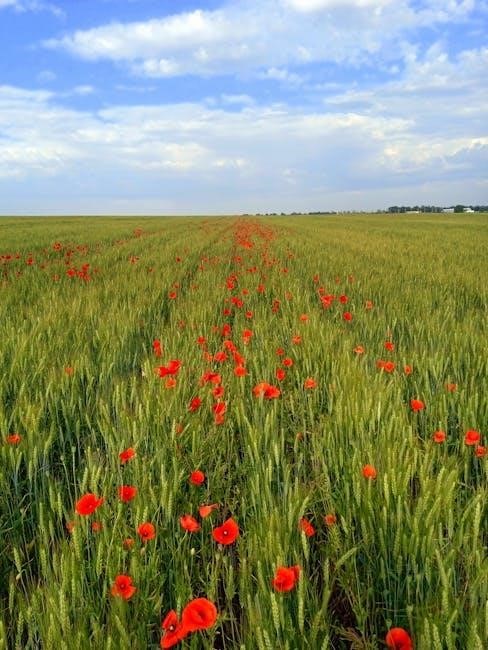
The area’s unique soil composition, disturbed by constant shelling, fostered the prolific growth of poppies – a vibrant splash of color amidst the destruction. These poppies became inextricably linked to the sacrifices made by soldiers on the Western Front, inspiring McCrae’s iconic imagery.
Accessing digital resources, such as a “In Flanders Fields” PDF, requires vigilance regarding cybersecurity. Recent Windows updates (KB5074109, KB5085516, KB5079473) emphasize the need for robust system protection. Downloading PDFs from untrusted sources poses risks of malware infection or data compromise.
The battles fought in Flanders – Ypres, Passchendaele – were characterized by horrific casualties and limited territorial gains. The sheer scale of suffering and loss profoundly impacted those who experienced it firsthand, shaping the poem’s somber tone and enduring message.
The Poem’s Structure and Form
“In Flanders Fields” is a lyrical poem comprised of four stanzas, each containing fourteen lines. This structure adheres to the traditional sonnet form, though McCrae deviates from strict Petrarchan or Shakespearean conventions. The poem’s concise and impactful nature contributes to its lasting power.
The poem’s accessibility is enhanced by its relatively straightforward language and imagery. However, its depth lies in the layered symbolism and emotional resonance. Digital versions, like a “In Flanders Fields” PDF, preserve the original formatting and intent.
Recent Windows updates (KB5074109, KB5085516, KB5079473) highlight the importance of secure digital access. When downloading a PDF, verifying the source is crucial to avoid potential security threats. Microsoft’s support resources offer guidance on protecting your devices.
The poem’s form mirrors the cyclical nature of life and death, reflecting the constant renewal symbolized by the poppies blooming amidst the graves. The structured verses provide a framework for exploring themes of loss, remembrance, and the call to continue the fight for freedom;
Rhyme Scheme and Meter Analysis
“In Flanders Fields” employs a consistent rhyme scheme of ABAB CDCD EFEF GG, typical of English sonnets. This regular pattern contributes to the poem’s musicality and memorability. The final couplet delivers a powerful and direct message, emphasizing the call to action.

The meter is predominantly iambic pentameter, creating a natural and flowing rhythm. However, McCrae occasionally introduces variations to emphasize certain words or phrases, adding emotional weight. A well-formatted “In Flanders Fields” PDF will visually represent these rhythmic nuances.
Considering recent Windows updates (KB5074109, KB5085516, KB5079473), ensuring your system is secure is paramount when accessing digital content. Downloading a PDF requires vigilance; choose reputable sources to avoid malware or compromised files.
The interplay between rhyme and meter enhances the poem’s emotional impact. The predictable structure provides a sense of order amidst the chaos of war, while the subtle variations draw attention to key themes of sacrifice and remembrance. Microsoft’s support channels can assist with digital security concerns.

Symbolism of the Poppies
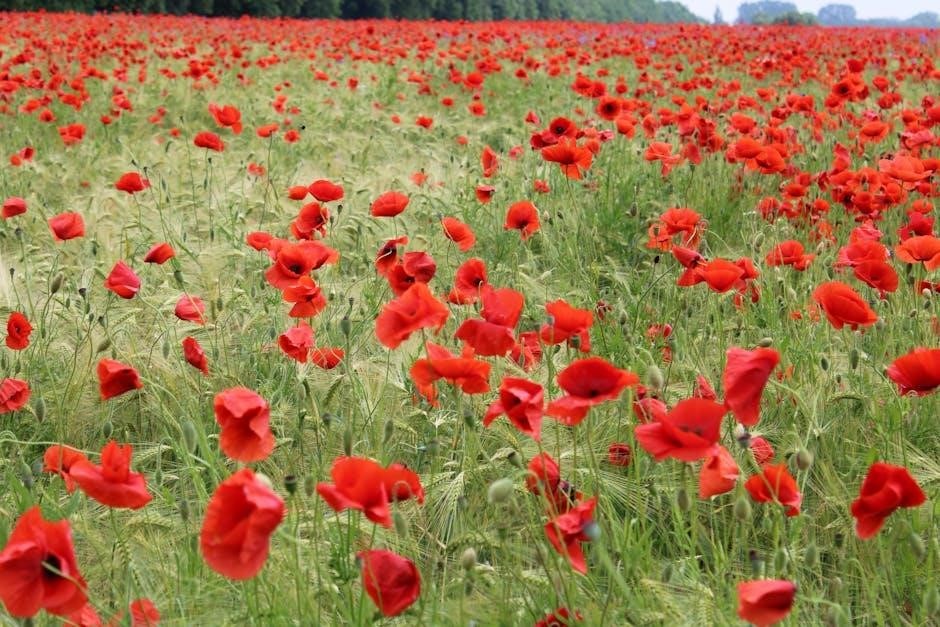
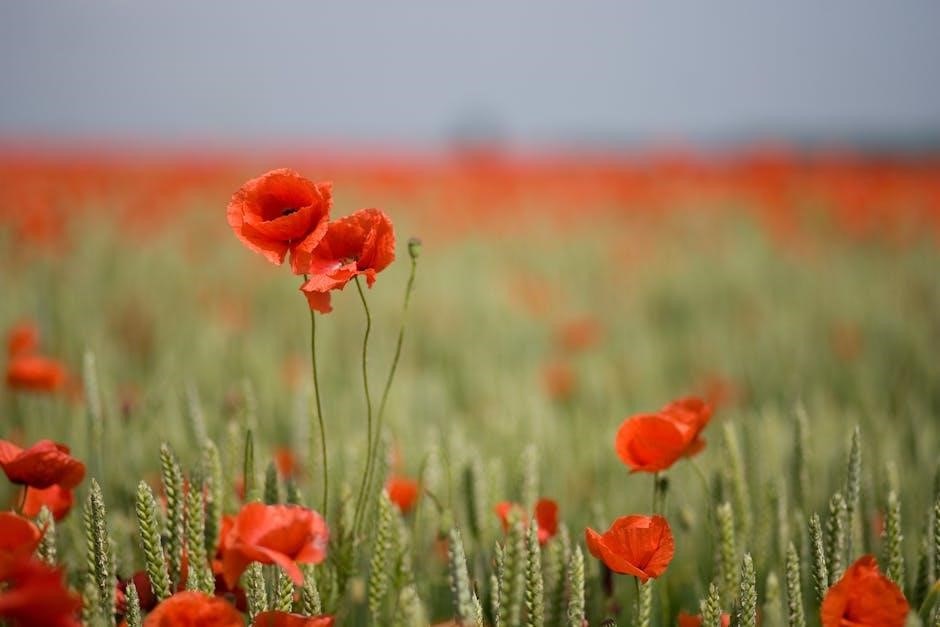
The poppies in “In Flanders Fields” are profoundly symbolic, representing both death and remembrance. They bloomed abundantly in the disturbed earth of battlefields, becoming a poignant visual reminder of the sacrifices made during World War I. Their vibrant red color evokes the blood shed by soldiers.
A high-quality “In Flanders Fields” PDF often includes imagery of poppies, reinforcing this central symbol. However, be cautious when downloading PDFs; recent Windows updates (KB5074109, KB5085516, KB5079473) underscore the importance of cybersecurity.
Beyond death, the poppies also symbolize renewal and hope. Their ability to flourish in a desolate landscape suggests the possibility of life emerging from destruction. This duality adds depth to the poem’s message.
Microsoft’s account dashboard offers resources for managing your digital security. When seeking a PDF version, prioritize legitimate sources to protect your system. The poppy’s enduring presence serves as a call to remember and honor those who served, a message amplified by accessible and secure digital resources.
The Meaning of “In Flanders Fields” ー First Stanza

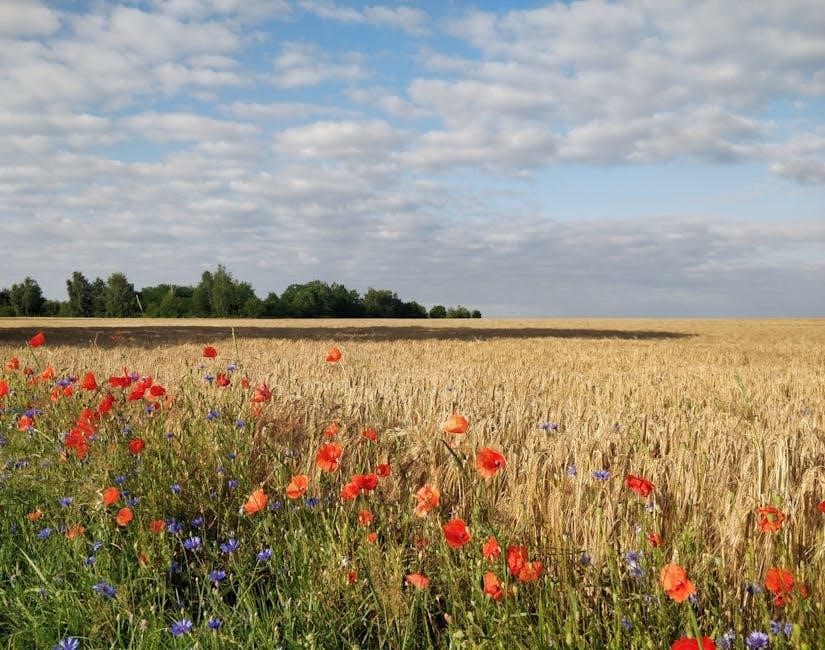
The first stanza of “In Flanders Fields” vividly depicts a scene of death and remembrance on the Western Front. It introduces the imagery of poppies growing amongst the crosses marking soldiers’ graves, immediately establishing a somber tone. The stanza’s opening lines describe the poppies blowing “between the crosses, row on row,” emphasizing the sheer scale of loss.
Accessing a “In Flanders Fields” PDF can offer a closer examination of the poem’s text. However, recent Windows updates (KB5074109, KB5085516, KB5079473) highlight the need for vigilance regarding online security when downloading files.
The stanza’s mention of the “white crosses” symbolizes the Christian faith of many soldiers and serves as a visual representation of their sacrifice. The sound of larks singing overhead provides a stark contrast to the death below, hinting at the continuation of life despite the horrors of war.
Microsoft’s support resources offer guidance on protecting your account. When seeking a PDF version, prioritize legitimate sources to avoid potential risks. The first stanza powerfully sets the stage for the poem’s broader themes of loss, remembrance, and the call to continue the fight.
Interpretation of the Second Stanza
The second stanza shifts from descriptive imagery to the personal experience of the fallen soldiers. It reveals that the soldiers who lie in those fields are not at peace, but rather feel a sense of incompleteness and longing. They observe the living world – the movement of clouds, the glow of the sun, and the flow of the river – yet remain detached from it.
Finding a reliable “In Flanders Fields” PDF is crucial for accurate study. Be mindful of online security, as recent Windows updates (KB5074109, KB5085516, KB5079473) emphasize the importance of protecting your system from potential threats when downloading files.
The lines “We see no glory, but we feel the pain” directly challenge romanticized notions of war. The stanza emphasizes the brutal reality of death and the enduring suffering of those who have fallen. They are aware of the world continuing without them, a poignant and heartbreaking realization.
Microsoft’s account dashboard provides tools for managing your security settings. Prioritize legitimate sources when accessing the poem’s PDF to ensure a safe download. The second stanza powerfully conveys the soldiers’ perspective, highlighting the tragic consequences of war and their yearning for remembrance.
The Third Stanza: A Call to Action
The third stanza marks a pivotal shift in the poem, transitioning from lament to a direct appeal to the living. McCrae implores the reader to take up the “torch” – the responsibility to continue the fight for which the fallen soldiers gave their lives. This is not a glorification of war, but a solemn request to honor their sacrifice through continued dedication.
When seeking a “In Flanders Fields” PDF, remember recent Windows security updates (KB5074109, KB5085516, KB5079473) underscore the need for vigilance against online threats. Utilizing Microsoft’s support resources can aid in maintaining a secure digital environment.
The lines “If ye break faith with us who die / We shall not sleep” are arguably the most famous and impactful in the poem. They convey a powerful sense of accountability, suggesting that the soldiers’ rest depends on the living upholding their ideals and continuing the struggle.
Accessing Microsoft’s account dashboard allows for management of personal information and security. Prioritize verified sources for PDF downloads. The stanza’s call to action is a potent reminder of the enduring legacy of those who have fallen and the obligation to ensure their sacrifice was not in vain.
The Poem’s Fourth Stanza and its Significance
The final stanza introduces a stark vision of a future where the fight is lost, and the ideals for which the soldiers died are forgotten. It depicts a world consumed by conflict, where even death offers no escape from the horrors of war. This serves as a chilling warning of the consequences of inaction.
When searching for a “In Flanders Fields” PDF, be mindful of recent Windows updates (KB5074109, KB5085516, KB5079473) emphasizing online security. Microsoft Edge offers built-in security features, while other browsers require careful configuration.
The imagery of brokenness – shattered lances and broken swords – symbolizes the complete collapse of civilization and the triumph of brutality. The stanza’s power lies in its ability to evoke a sense of dread and urgency, reinforcing the call to action from the previous stanzas.
Utilizing Microsoft’s support and account management tools can help protect your digital information. The fourth stanza’s significance resides in its unflinching portrayal of a dystopian future, urging readers to actively prevent such a fate. It’s a powerful conclusion to a poem steeped in remembrance and responsibility.
“In Flanders Fields” as a War Poem
“In Flanders Fields” transcends a simple lament for the fallen; it’s a potent anti-war statement disguised as a patriotic plea. While initially appearing to glorify sacrifice, the poem’s core message is a desperate call to prevent further bloodshed. McCrae vividly depicts the brutal realities of trench warfare, the constant presence of death, and the psychological toll on soldiers.
When seeking a “In Flanders Fields” PDF, remember recent Windows security updates (KB5074109, KB5085516, KB5079473) are crucial for safe browsing. Microsoft 365 and Office 2024 users should ensure their software is current.
The poem’s power lies in its ability to personalize the immense scale of loss. The individual poppies, representing the graves of fallen soldiers, become symbols of irreplaceable lives cut short. It’s a visceral response to the horrors witnessed firsthand by McCrae as a medical officer.
Accessing your Microsoft account dashboard provides tools for managing security settings. “In Flanders Fields” doesn’t romanticize war; it exposes its futility and demands that the living honor the dead by continuing the fight for peace, making it a cornerstone of war literature.
The Poem’s Impact on Remembrance Day
“In Flanders Fields” is inextricably linked to Remembrance Day, becoming its defining literary symbol. Published during World War I, the poem quickly resonated with a public grappling with unprecedented loss. Its evocative imagery of poppies blooming amidst the graves of soldiers provided a powerful visual for mourning and remembrance.
Searching for a “In Flanders Fields” PDF requires vigilance regarding online security. Recent Windows updates (KB5074109, KB5085516, KB5079473) are vital for protecting your system. Utilizing Microsoft Edge or Chrome with appropriate configurations is recommended.
Moina Michael, inspired by the poem, popularized the use of the poppy as a symbol of remembrance, leading to the creation of the Poppy Appeal. This tradition continues today, with millions of poppies distributed annually to raise funds for veterans’ support.
Remembrance Day ceremonies worldwide often feature readings of “In Flanders Fields,” reinforcing its enduring message of sacrifice and the importance of honoring those who served. Accessing Microsoft support resources can aid in managing your account and ensuring secure online experiences while exploring the poem’s legacy.
“In Flanders Fields” and the Poppy Appeal
The Poppy Appeal’s origins are deeply rooted in “In Flanders Fields.” Moina Michael, profoundly moved by McCrae’s poem, vowed to always wear a red poppy in remembrance of fallen soldiers. She initiated a movement that quickly gained traction, particularly after being inspired by the poem’s imagery.
Downloading a “In Flanders Fields” PDF necessitates caution. Recent Windows updates – KB5074109, KB5085516, and KB5079473 – are crucial for maintaining system security. Utilizing a secure browser like Microsoft Edge, configured correctly, is advisable.
The first official Poppy Appeal was launched in 1921 by the British Legion, building upon Michael’s initiative. The poppy became a potent symbol of remembrance, representing both the sacrifice of soldiers and the hope for peace. Funds raised support veterans and their families.
Today, the Poppy Appeal remains a significant fundraising event globally. Accessing your Microsoft account dashboard allows for managing subscriptions and ensuring payment security while researching the poem and its associated charitable efforts. The poem’s legacy continues to bloom with every poppy worn.
Availability of “In Flanders Fields” PDF Versions
Numerous sources offer “In Flanders Fields” as a PDF, ranging from educational websites to online libraries. However, exercising caution when downloading is paramount, especially considering recent Windows security updates like KB5074109, KB5085516, and KB5079473, which address potential vulnerabilities.
Legitimate educational institutions and historical societies frequently provide free, verified PDF versions. These are generally safe and reliable. Conversely, unverified sources pose risks, potentially containing malware or altered content. Always prioritize trusted domains.
Microsoft’s support resources emphasize the importance of account security and safe browsing practices. Utilizing Microsoft Edge with appropriate configuration, or carefully selecting “Save File” in Firefox, can mitigate risks. Regularly updating your operating system is also crucial.
PDF formats vary – some are text-searchable, while others are image-based scans. Text-based PDFs are preferable for accessibility and copying. Before downloading, assess the source’s reputation and scan the file with antivirus software. Your Microsoft account dashboard provides tools for managing security settings.
Legitimate Sources for PDF Downloads
Reliable PDF downloads of “In Flanders Fields” are readily available from several trusted sources. Government websites, particularly those related to Veterans Affairs or national archives, consistently offer verified copies. Educational institutions, including universities and school districts, frequently host the poem in PDF format for educational purposes.
The Canadian War Museum and similar historical organizations are excellent resources, ensuring accuracy and authenticity. Project Gutenberg, a repository of free ebooks, may also contain a digitized version, though verification is still advised. Remember recent Windows updates (KB5074109, KB5085516, KB5079473) highlight the need for online safety.
Reputable poetry websites dedicated to classic literature often provide downloadable PDFs. Always check the website’s “About Us” section to confirm its legitimacy. Avoid sites with excessive advertising or suspicious download prompts. Prioritize sources that clearly state their copyright information.

Microsoft’s support emphasizes protecting your account. Utilizing secure browsing practices and regularly updating your system, as recommended by Microsoft, are vital when accessing online resources like PDFs.
Potential Risks of Downloading PDFs from Unverified Sources
Downloading PDFs of “In Flanders Fields” from untrustworthy websites carries significant risks. Malware and viruses can be embedded within seemingly harmless PDF files, compromising your device and data. Phishing attempts may masquerade as legitimate downloads, aiming to steal your personal information or Microsoft account credentials.
Unverified sources often distribute altered or inaccurate versions of the poem, diminishing its historical and artistic integrity. Aggressive advertising and pop-up windows are common on dubious sites, disrupting your browsing experience and potentially installing unwanted software. Recent Windows updates (KB5074109, KB5085516, KB5079473) address security vulnerabilities, but vigilance remains crucial.
Compromised PDFs could exploit vulnerabilities in your PDF reader, granting attackers access to your system. Data breaches are a serious concern if the downloaded file contains malicious code designed to harvest sensitive information. Microsoft Edge and other browsers offer security features, but they aren’t foolproof.
Always prioritize legitimate sources and exercise caution when downloading any file from the internet. Regularly scan your system with updated antivirus software and heed Microsoft’s security recommendations.
Analyzing Different PDF Formats (e.g., Text, Image)
“In Flanders Fields” PDFs exist in various formats, each with unique characteristics. Text-based PDFs allow for easy searching, copying, and accessibility features, ideal for study and analysis. However, formatting inconsistencies can occur. Image-based PDFs, often scans of original documents, preserve the poem’s visual presentation but lack text searchability.
Optical Character Recognition (OCR) can convert image-based PDFs into searchable text, though accuracy varies. Hybrid PDFs combine text and images, offering a balance between searchability and visual fidelity. File size differs significantly; image-based PDFs are generally larger than text-based ones.
Recent Windows updates (KB5074109, KB5085516, KB5079473) improve PDF rendering capabilities within Microsoft Edge and other applications. PDF accessibility is crucial for users with disabilities; ensure the chosen format supports screen readers and other assistive technologies.
Analyzing the PDF’s creation date and source can indicate its authenticity. Consider the intended use when selecting a format – research favors text-based PDFs, while preserving historical appearance benefits from image-based versions. Always verify the content against reliable sources;
Educational Uses of the Poem and PDF Resources
“In Flanders Fields” PDFs serve as valuable educational tools across various disciplines. Literature classes utilize the poem for analyzing themes of war, loss, and remembrance. History lessons contextualize it within the First World War, exploring the battlefield of Flanders and McCrae’s experiences.
PDF resources facilitate close reading, annotation, and textual analysis. Teachers can create worksheets and discussion questions based on the poem’s content. Digital PDFs allow for interactive learning experiences, incorporating multimedia elements and online research.
Recent Windows updates (KB5074109, KB5085516, KB5079473) enhance PDF compatibility with educational software and platforms. Microsoft Edge provides built-in annotation tools for student engagement. Accessibility features within PDFs ensure inclusivity for all learners.
PDFs can be integrated into presentations, research projects, and creative writing assignments. Encourage critical thinking by asking students to compare different interpretations of the poem. Promote digital literacy by teaching responsible PDF sourcing and evaluation.
“In Flanders Fields” in Literature and Art
“In Flanders Fields” has profoundly impacted literature and art, inspiring countless works reflecting on war and remembrance. The poem’s imagery, particularly the poppies, frequently appears in paintings, sculptures, and musical compositions. PDF versions of the poem facilitate easy access for artists and writers seeking inspiration.
Numerous anthologies include McCrae’s work, ensuring its continued presence in literary studies. The poem’s themes resonate with other war poetry, prompting comparative analyses. Digital PDFs allow for convenient sharing and collaboration among artists and scholars.
Recent Windows updates (KB5074109, KB5085516, KB5079473) improve the display quality of artistic reproductions within PDF documents. Microsoft’s support for various image formats ensures faithful representation of artwork inspired by the poem.
The poem’s enduring legacy is evident in its adaptation into various artistic mediums. PDFs containing critical essays and artistic interpretations offer valuable insights. Exploring these connections enriches understanding of both the poem and the broader cultural response to war.
Translations of “In Flanders Fields”
“In Flanders Fields” has been translated into numerous languages, extending its message of remembrance globally. These translations aim to preserve the poem’s emotional impact and thematic depth while adapting to linguistic nuances. PDF versions of these translations are increasingly available online, fostering cross-cultural understanding.
Access to translated PDFs allows readers worldwide to connect with McCrae’s poignant verses in their native tongues. Microsoft’s commitment to accessibility ensures compatibility across various devices and platforms. Recent Windows updates (KB5074109, KB5085516, KB5079473) enhance the rendering of non-English characters within PDF documents.
The availability of digital translations facilitates comparative literary studies, revealing how different cultures interpret the poem’s symbolism. PDFs often include annotations and contextual information, enriching the reading experience. Microsoft account dashboards provide secure access to these resources.
Exploring these translations highlights the universal themes of loss, sacrifice, and the enduring power of memory. PDFs serve as valuable tools for educators and researchers seeking to promote global awareness and empathy.
Criticism and Scholarly Analysis of the Poem
“In Flanders Fields”, while widely revered, has also faced critical scrutiny. Some scholars argue its later stanzas, particularly the call to arms, deviate from the initial elegiac tone. Access to scholarly articles, often available as PDFs, provides diverse perspectives on the poem’s complexities.
PDF versions of academic journals and literary critiques offer in-depth analyses of McCrae’s poetic techniques and the historical context of the work. Microsoft’s support for PDF accessibility ensures these resources are available to a broad audience. Recent Windows updates (KB5074109, KB5085516, KB5079473) improve PDF rendering and search functionality.
Critics debate the poem’s potential glorification of war versus its genuine lament for the fallen. PDF documents containing biographical information about McCrae shed light on his motivations and experiences. Microsoft account access streamlines the process of locating and managing these scholarly resources.
Analyzing these critiques reveals the poem’s enduring power to provoke discussion and challenge conventional interpretations. PDFs facilitate detailed textual analysis and comparative studies, enriching our understanding of this iconic work.
Modern Relevance of the Poem’s Message
“In Flanders Fields” continues to resonate deeply in the 21st century, serving as a potent reminder of the human cost of conflict. The poem’s call to remember those who sacrificed their lives transcends specific historical contexts, prompting reflection on contemporary conflicts and the importance of peace. Accessing the poem in PDF format allows for easy sharing and study.
PDF resources, often supported by Microsoft’s operating system updates (KB5074109, KB5085516, KB5079473), facilitate educational initiatives focused on war remembrance. The poem’s message of honoring the fallen remains particularly relevant during Remembrance Day observances globally.
Digital accessibility, enhanced by Microsoft Edge and Microsoft account integration, ensures the poem reaches diverse audiences. PDF versions enable translation and adaptation for various cultural contexts, broadening its impact. The poem’s themes of duty, sacrifice, and remembrance are universally applicable.
Contemporary interpretations emphasize the poem’s anti-war sentiment and its plea for a future free from conflict. PDF documents containing analyses of the poem’s symbolism contribute to ongoing dialogue about its enduring significance.